"I believe that the unity of mind and body is an objective reality. They are not just parts somehow related to each other, but an inseparable whole while functioning. A brain without a body could not think … the muscles themselves are part and parcel of our higher functions."
~Moshe Feldenkrais
The concept of movement in the kindergarten classroom is not new. Kindergarten teachers around the globe know that young children love to move. The truth is, children need to move. As the academic expectations placed on kindergarten students have grown, many teachers have replaced opportunities to move with long periods of time on the carpet listening to instruction. It is no surprise, then, that the number of referrals for ADHD and behavior related concerns has risen. Has children's development changed? I would argue, no. I believe that children are perhaps not spending time moving outside of school as much as they have in the past, but time devoted to movement in school has reduced as well.
Brain Breaks, Sensory Breaks, Movement Breaks, Oh, My!
Like many teachers, I have tried to counteract the reality of decreased physical activity by having regularly scheduled brain breaks and movement breaks. Go Noodle and Adventure to Fitness have been great companions the past few years. Too, I have found ways for students who need them to have sensory breaks outside the classroom. This year, however, I have switched my focus from planned movement breaks to finding ways to integrate movement in the classroom.
Hopefully, we all have people in our professional lives who encourage us to stretch our thinking. One of mine is our Occupational Therapist, Eric. Eric has a way of planting a seed in my head, knowing that it will perhaps sit dormant until it is ripe for growing, but at the same time believing that it will. This has happened time and time again. One such seed is the belief that movement should occur naturally throughout the day. I am not completely there yet, but I have been finding ways to make integrated movement a reality.
Honoring Students' Knowledge of What Their Bodies Need
Most students know what their body needs to feel comfortable. For some, it is sitting cross-legged on the carpet, for others it is kneeling. This year, in my classroom, I have chosen to allow both, as long as it does not impair another student's ability to see or interact with the lesson. I also let my students sit wherever they choose on the rug--again, as long as they respect another's right to learn. I recognize that some students are not ready to handle this much choice, yet, and in those cases I designate a specific area just for them, which seems to help them regulate.
I extend this same philosophy to work time. I do not have assigned spots at tables. In fact, students have the choice to work at a table, sitting on the floor with a clipboard on their lap, standing up at a table or shelf, or lying down--which does double duty by helping to strengthen a child's core (Another tidbit I learned from Eric).
I love that this picture captured the boy on the right checking his pencil grip!

Another way I like to honor students' knowledge of what their bodies need is by having self-selected snack time. Students are allowed to decide if they would like to have their snack time in the morning or afternoon, and then decide when during discovery time they would like to take that snack break.
Building Movement Into the Lesson
One thing I am trying to do this year is keep my mini-lessons short so the students do not have to sit for long periods at a time. I have tried to find ways to get the students up and moving during the lesson. Just yesterday, we did a math lesson, which required the students to trace the face of four different 3-dimensional shapes. I placed one shape at each table and students had to rotate around to trace them. I gave them no directions in regard to how they had to do it, because I also wanted them to work on the social skills of taking turns, resolving conflict (and there was some conflict), working with others, and problem solving. Once they finished, we had a short debriefing on the rug before the students worked on their individual practice activity.
Likewise, for a lesson involving positional words, I took the children outside so they could demonstrate their knowledge of positional words on the playground equipment.
Providing Opportunities for Movement Through Discovery Time Play
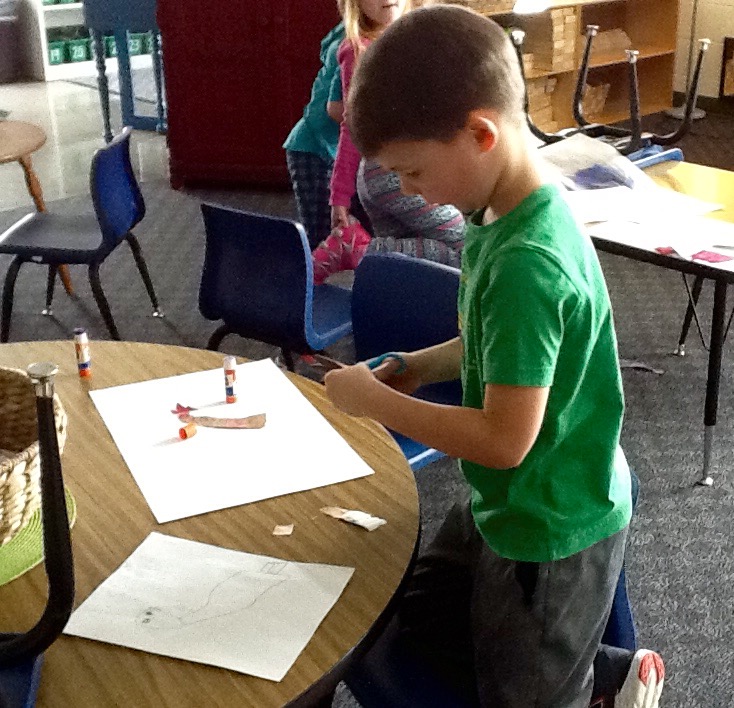
A simple way to integrate movement into the kindergarten day is through the activities provided during discovery time. As you can see in the pictures below, some activities are done while standing, some while sitting and some while lying down. In addition, I try to plan activities which will require gross motor and fine motor movements.
This boy's fine motor control was impressive to witness. It carries through to his handwriting skills as well!
Why Should We Integrate Movement In Our Classrooms?
Simple-- the obvious desire of having students able to attend to lessons when needed. Integrating movement into our classrooms gives the body what it needs to function well--thereby allowing the mind to do so, too. Plus, children are happier when they are allowed to move. Aren't we all?
"We have a brain for one reason and one reason only -- that’s to produce adaptable and complex movements. Movement is the only way we have affecting the world around us… I believe that to understand movement is to understand the whole brain. And therefore it’s important to remember when you are studying memory, cognition, sensory processing, they’re there for a reason, and that reason is action."
~Daniel Wolpert, neuroscientist